Online shopping is a routine part of life across Europe, and mobile devices account for much of e-commerce activity. If you're still selling only through Instagram or marketplaces – you're losing money every day.
But here's the question that stops most business owners: "What should I build my online store on?" Shopify, WordPress with WooCommerce, OpenCart, custom development – there are dozens of options and no clear answer. Every studio promotes their platform, every freelancer – their own.
Over 7+ years at Artbrain, we've built dozens of online stores – from small catalogs with 50 products to full-scale e-commerce platforms with 4,200+ products, AI integration, and 4-supplier synchronization. We've seen businesses outgrow Shopify within a year, WooCommerce stores crash under load, and properly built custom platforms run for years without issues.
Three paths to launching an online store in 2026, compared honestly. Real prices, hidden costs and concrete recommendations from our own projects.
The E-Commerce Market: Why Now
Before choosing a platform, let's look at the numbers:
- Mobile-first shopping – a core expectation for European buyers
- 11 million online shoppers, averaging 17 purchases per year
- 60% of orders are placed from mobile devices
- 9.6% annual growth – the market continues to expand
When custom development pays off
Turnkey development makes sense when a ready-made platform gets in the way of a non-standard catalogue, your own processes, or required integrations. Development starts at €4,500 and takes 4-8 weeks. One example is Airstep, a Django store with 6,700+ products, automatic imports from XML feeds by three suppliers, and instant search.
Estimate my storeThree Ways to Build an Online Store
There are three fundamentally different approaches. Each has its own advantages, limitations, and pitfalls.
Shopify – Fast and Simple, But With Fees on Every Sale
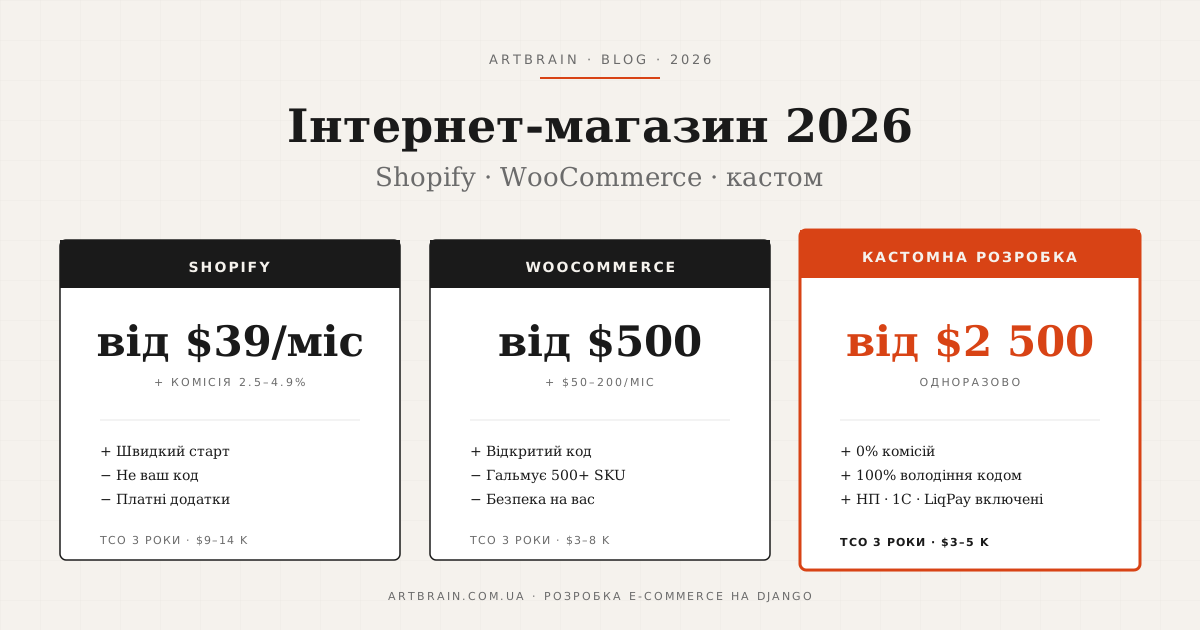
Cost: from $39/month + 2.5-2.9% commission on every sale
Shopify is a SaaS platform where everything is included: hosting, SSL, templates, payment processing. Sign up, choose a theme, add products – and your store is live.
When Shopify Is Right
- You're testing a niche and aren't sure about demand
- Small catalog – under 100 products
- You need a store yesterday
- You're selling primarily to US/European markets
Shopify Problems
Commission on every sale. Shopify charges 2.5-2.9% + $0.30 per transaction. If you use a third-party payment gateway – add another 2%. Sold $5,000/month? That's $125-245 in fees. Every month.
Limited localization. Shopify may require paid apps for a carrier's API or local payment methods, each costing $10–50/month. Integration with your accounting system is a separate headache.
Paid apps for everything. Product filters? $15/month app. Multi-language? $20/month. Advanced analytics? $30/month. These "small" costs add up to $500-1,500/year.
You don't own the code. Shopify is a rental. If they raise prices, change terms, or block your account – you lose everything.
Real Shopify Cost Over 3 Years
| Expense | Monthly | 3 Years |
|---|---|---|
| Subscription (Basic) | $39 | $1,404 |
| Apps (5-7) | $80-150 | $2,880-5,400 |
| Sales commission ($5K/mo) | $125-245 | $4,500-8,820 |
| Paid theme | – | $180-400 |
| Total | $244-434 | $9,684-13,504 |
WordPress + WooCommerce – Flexible and Cheap, But Needs Hands
Cost: from €900 (setup) + €50-200/month (hosting & maintenance)
WooCommerce is a free WordPress plugin that turns any site into an online store. The most popular solution globally – over 36% of all online stores run on WooCommerce.
When WooCommerce Is Right
- Limited budget but you have time to learn
- Catalog under 500 products
- Blog and content marketing are important (WordPress is best for SEO)
- You have a technical person to maintain the site
WooCommerce Problems
Security. WordPress is target #1 for hackers. Plugin updates, backups, monitoring – that's your responsibility.
Speed under load. 500+ products, 1,000+ daily visitors – and WooCommerce starts to struggle.
Plugin on plugin. A typical WooCommerce store uses 15-25 plugins. Each updates separately, each can conflict with others.
Hidden costs. “Free” WooCommerce actually costs:
| Expense | Cost |
|---|---|
| Hosting (proper hosting, not $3/month) | $15-50/month |
| Paid theme | $60-100 (one-time) |
| Premium plugins (5-10) | $200-500/year |
| SSL certificate | Free (Let's Encrypt) |
| Developer maintenance | €100-350/month |
| Total for the first year | €1,500-5,500 |
Custom Development – Expensive to Start, Cheap Forever
Cost: from €4,500 (Artbrain) to €27,000 (complex projects)
When Custom Is Right
- 500+ products or complex category structure
- Integration with suppliers and accounting tools needed
- High traffic – 1,000+ visitors daily
- Unique business logic: calculators, configurators, B2B pricing
- You plan to scale
Why Custom Pays Off
Zero commissions. Unlike Shopify, you don't pay a percentage of sales. At $5,000/month revenue, this saves $1,500-3,000/year.
Speed. No template bloat – custom stores load in 0.5-1 seconds.
Full ownership. The code is yours. The data is yours. No one can raise your prices or block your account.
Real Case: Airstep Online Store
We built the Airstep shoe store (airstep.com.ua) – a full e-commerce platform:
- 4,242 products in 73 categories with automatic sync from 4 suppliers
- AI-generated descriptions – Claude AI creates unique descriptions and SEO tags
- Smart search with typo tolerance (Meilisearch)
- Automatic image conversion to WebP
- Custom CMS admin panel
Stack: Django 4.2, PostgreSQL, Meilisearch, Celery, Redis. Full case study – in a separate article.
Comparison Table: Shopify vs WooCommerce vs Custom
| Criteria | Shopify | WooCommerce | Custom |
|---|---|---|---|
| Starting cost | $39/mo | €900-2,700 | from €4,500 |
| Monthly costs | $200-400+ | €100-350 | $10-50 (hosting) |
| Sales commission | 2.5-4.9% | 0% | 0% |
| 3-year TCO | $9-14K | €5.4K-14.4K | €5.4K-9K |
| Launch time | 1-3 days | 2-4 weeks | 4-8 weeks |
| Max. products | Unlimited | ~1,000 (slows down beyond that) | Unlimited |
| Carrier integration | Via app ($) | Via plugin | Built in |
| Payment provider | Via app ($) | Via plugin | Built in |
| SEO | Basic | Excellent | Excellent |
| Security | Shopify is responsible | Your responsibility | Built in |
| Code ownership | No (rental) | Yes | Full |
| Scalability | Fees grow | Needs expensive hosting | Costs stay flat |
How to Choose: Step by Step
Forget about platforms and start with your business. Answer five questions:
1. How many products do you have?
- Up to 100: Shopify or WooCommerce
- 100–500: WooCommerce or custom development
- 500+: custom development only
2. What is your monthly turnover, or planned turnover?
- Up to $1,000/month: Shopify or WooCommerce, while commissions are still insignificant
- $1,000–5,000/month: WooCommerce or custom development, as Shopify fees start to add up
- $5,000+/month: custom development, which pays for itself in 6–12 months
3. Do you need integration with Ukrainian services?
- Carrier APIs, payment methods, and your accounting system: custom development can provide these natively
- Only basic delivery and payments: Shopify or WooCommerce can handle it
4. Do you have a technical specialist on the team?
- No: Shopify, where the platform handles maintenance, or custom development, where the studio does
- Yes: WooCommerce can be maintained in-house
5. What are your plans for the next 2–3 years?
- “I don’t know, I’m testing”: Shopify, with minimal risk
- “Growth and scaling”: custom development, an investment rather than an expense
Common Platform Selection Mistakes
Over the years, we have seen the same mistakes repeatedly. These are the five most expensive:
1. Choosing by initial price. Shopify at $39/month looks cheaper than custom development at €4,500. But after 3 years Shopify costs $9,000–14,000, while custom development costs €5,400–9,000 including development. Calculate TCO, the total cost of ownership.
2. Ignoring the mobile version. Mobile shopping is essential for European buyers. If your store is inconvenient on mobile, you lose customers. Check your website with our free website checker.
3. Not thinking about SEO. A store without SEO is like a store without a sign. Google is the main source of free traffic. Shopify limits SEO capabilities; WooCommerce and custom development give you full control.
4. Saving on hosting. $3/month hosting means a slow site, and customers leave. Every second of loading time lowers conversion by 7%. Proper hosting for an online store starts at $15/month.
5. Launching everything at once. “I want a store, CRM, bot, mobile app, and AI recommendations.” The result is that nothing works properly. The right strategy is to launch an MVP, begin selling, then add functionality.
How Much an Online Store Costs at Artbrain
We do not hide our prices.
Turnkey online store development starts at €4,500. The final price depends on the number of products, catalogue complexity, and integrations with payment systems and delivery services. Every project is discussed individually: we analyze your business and propose the best solution for your budget.
Want to know an estimated cost? Use the cost calculator to get an approximate price in a minute.
Every project includes:
- Custom design for desktop and mobile
- Responsive layout that looks right on any device
- Carrier and payment-provider integration
- SEO optimization from day one
- Admin panel for products, orders, and customers
- 60 days of free support after launch
- Google Analytics and Search Console setup
Frequently Asked Questions
Can I Start with Shopify and Move to Custom Development Later?
Technically, yes, but in practice this means building a new store from scratch. Shopify does not let you export templates, logic, or integrations, only the product and order database. We have seen clients spend $10,000+ on Shopify over 2 years and then another €9,000 on migration. If you plan to grow, start with custom development.
How Long Does Store Development Take?
An online store takes 4–8 weeks. A complex project such as Airstep takes 8–12 weeks. We always start with an MVP, a minimum version that can launch and begin selling, then add functionality in iterations.
What If I Already Have a WooCommerce Store?
If it works and sells, do not rebuild it just for the sake of rebuilding. But if you face speed, security, or scaling problems, contact us for a free consultation. We will honestly say whether migration is needed or optimization is enough.
Does an Online Store Need a Mobile App?
In 2026, no. If your site is fast and convenient on mobile, as it should be, a separate app is an unnecessary expense. A Progressive Web App provides the same experience without native app development. Consider an app only with turnover from €90,000/month and a base of 10,000 active customers.
Conclusion: What Should You Choose?
There is no universal answer. There is an answer for your specific business:
- Testing a niche with a minimal budget: Shopify. Launch in a day and find out whether demand exists. If it does not, you can close without major losses.
- Content and a store, with technical resources: WordPress + WooCommerce. The best option for content marketing.
- A serious business planning to grow: custom development. An investment that pays for itself in 6–12 months.
Don't choose the cheapest option. Choose what will work for your business for the next 3-5 years.
Ready to order turnkey online store development? Submit your request – free consultation, transparent pricing from €4,500, delivery in 4–8 weeks. No pressure.
See our completed projects and full list of development services, or use our cost calculator. Already have a website? Check it with our free website checker.
Also read: Airstep Case Study – Django E-Commerce with AI and 4-Supplier Sync
FAQ
What is better for an online store: Shopify, WordPress, or custom development?
Shopify – for quick launch from $39 a month, but limited customization and transaction fees. WordPress + WooCommerce – free engine with full control, but requires hosting and technical knowledge. Custom development (from €4,500) – maximum flexibility, integration with any services, full control. For stores that need local payment and carrier integrations, custom is often the better choice.
How much does it cost to create an online store in 2026?
The price depends on scope, integrations and timeline. We prepare an exact estimate after a free review of your task.
Do I need an online store if I sell through Instagram?
Yes, Instagram is just an acquisition channel. A full store gives you: SEO traffic (free customers from Google), catalog with filters, automated order processing, shipping and payment integration, sales analytics. A business on Instagram alone depends on platform algorithms, while a website is your property.
What integrations does an online store need?
Essential: carrier integration (DHL, DPD, GLS: pickup points, parcel lockers, tracking), Stripe or PayPal (online payments), Google Analytics 4 + Search Console (analytics). Recommended: CRM for order management, Telegram bot for notifications, your accounting system (API or CSV export) for accounting, live chat. Custom development lets you integrate everything into a single system.