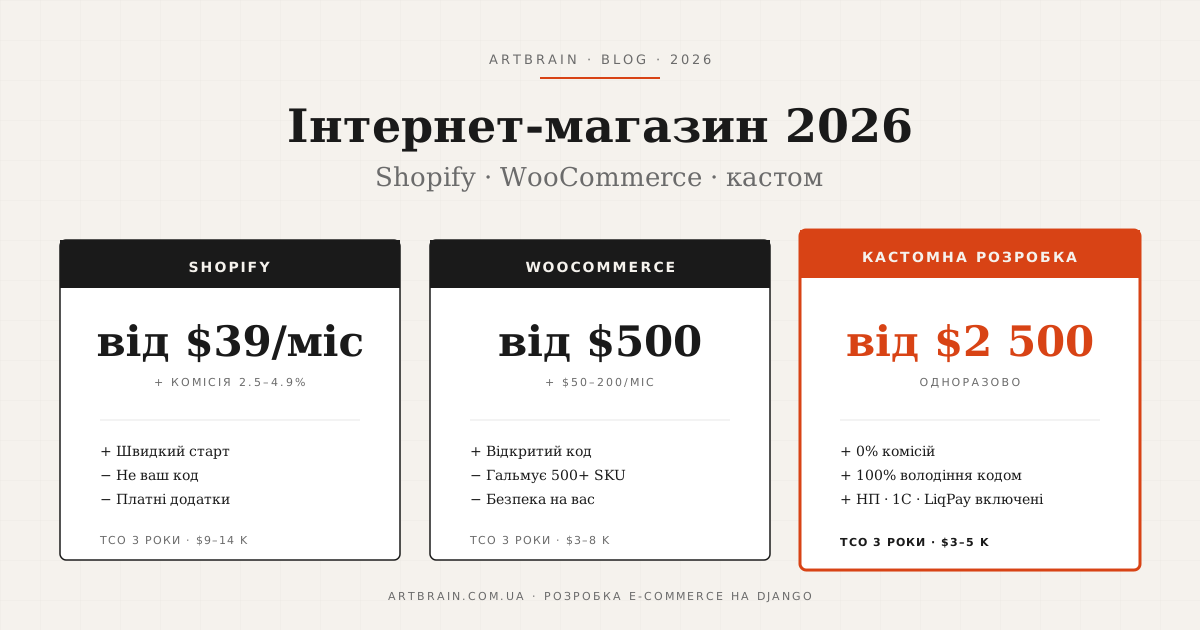
- An Artbrain custom store starts at €4,500, with online payment as a €450 indicative add-on.
- A priced first-year subtotal excludes storage, backups, carrier tariffs, compliance, content and VAT on services.
- A standard €80 EEA Stripe card payment costs €1.45 at the published German tariff.
- One-off Artbrain work costs €45 per hour; maintenance is from €200 per month after a review.
- EU selling can require work on withdrawal, price history, VAT, accessibility, privacy and invoicing.
A store budget is more than the number at the bottom of a development quote. For a European small or medium business, the useful number is the cost to launch, operate for a year and take each payment. That means separating build work from hosting, domain renewal, consent management, support, payment processing, product data, data protection and processor agreements, and country-specific compliance work.
How Much Does an Online Store Cost in 2026? A custom store from Artbrain starts at €4,500 and the public service page gives a 4–8 week delivery window for its starting scope. That is the launch layer, not a first-year total. Add the recurring services you select, such as a domain, hosting, a cookie-consent tool and maintenance after the included 60 days. Then add annual payment-processing costs based on every successful payment. A standard EEA card payment through Stripe Germany, for example, is 1.5% plus €0.25. EU selling also needs a budget line for returns, sale-price history, VAT setup, accessibility, data protection and processor agreements and, where relevant, domestic e-invoicing. A simple store can therefore begin at €4,950 when online payment is added; a data-heavy, multi-language store needs a different scope. Treat every figure here as indicative. The final scope, price and delivery plan should be fixed after a brief.
The first-year cost formula
A useful way to read any ecommerce proposal is:
First-year cost = launch work + fixed annual services, including chosen maintenance + annual payment-processing costs + compliance and accounting work.
| Cost layer | What belongs here | Why it is separate |
|---|---|---|
| One-off launch | Storefront, catalogue, checkout, agreed design, data import, integrations and migration | It pays for the work needed to go live. |
| Fixed recurring costs | Domain, hosting, paid tools, consent management and chosen maintenance | These renew even when no order is placed. |
| Cost per order | Payment gateway and, on some hosted platforms, a platform transaction charge | It rises with sales and payment method mix. |
| Compliance and finance work | Returns flow, VAT, price history, accessibility, privacy and country-specific invoicing | It depends on markets, products and business model. |
For a custom Artbrain store, the starting launch price is €4,500. The starting scope includes catalogue and cart functions, checkout, filtering and search, customer account and wishlist, administration and basic SEO. The starting scope covers delivery options at checkout, including pickup points and address delivery with one carrier connection. The calculator lists connecting a further named DHL, DPD or GLS carrier at €350. Online payment and data exchange with an accounting system are add-ons too, not assumptions hidden inside the base price. Ask for every required payment, carrier and back-office connection to be named in the written scope.
The ecommerce calculator is useful for a first configuration. Its figures are indicative prices, not a binding quote. A short project brief lets us confirm the catalogue, markets, integrations and delivery conditions before work starts.
Three ways to launch an online store
Hosted SaaS platform
A hosted platform suits a new shop with a conventional catalogue, a short deadline and a team willing to work within the platform’s checkout, data model and app ecosystem. Hosting and core technical operations are normally bundled into the subscription. On the Ireland pricing page, Shopify lists Basic, Grow and Advanced at €32, €92 and €384 per month on monthly billing, or €24, €69 and €289 per month when paid annually. If a merchant uses a third-party payment provider, the same plans add platform fees of 2%, 1% and 0.6% respectively, on top of the payment provider’s processing fee. Shopify Ireland pricing is clear that rates vary by country and exclude VAT.
Another model is Ecwid. Its European price page lists €5, €35, €65 and €149 monthly plans, with lower annual equivalents for all but Starter. Ecwid says it charges no platform transaction fee, although the payment gateway still charges for every transaction. That distinction matters. A platform subscription and gateway processing are not interchangeable costs. See the Ecwid price page for the current listed plans.
The limits are usually commercial rather than visual. A standard product catalogue may fit well, but supplier-specific availability rules, unusual dealer prices, exact data exchange with accounting or a complex migration can become workarounds, paid apps or a reason to choose another route. Before choosing SaaS, ask whether your payment method, target countries, product options, tax logic and data export are supported on the plan you will actually buy.
Open-source CMS
An open-source store can fit a business that wants control of its hosting and can accept responsibility for updates. The software licence itself does not settle the budget. Hosting, theme work, extensions, payment and delivery connectors, security updates, backups and maintenance remain real costs. It can be a sensible route for a familiar, relatively standard catalogue when the team has a clear owner for technical upkeep.
The main limit is often ownership of maintenance rather than ownership of code. A cheap initial build can become expensive if several extensions have overlapping duties, an update breaks checkout or no one knows who owns the hosting account. Ask for an extension list, renewal prices, update responsibility and a recovery plan before comparing it with a custom quote.
Custom development
Custom development suits a business whose store must reflect its actual data and operations: a supplier feed with complicated variants, stock synchronisation with the accounting system, a migration where search traffic matters, or a customer-specific price rule. At Artbrain, a store starts from €4,500 and the public service page states 4–8 weeks for the starting scope. The contract defines the final scope, price, timeline and payment milestones. In client projects, hosting accounts, code and data belong to the client, with code ownership transferring after final payment unless the contract says otherwise. The price includes 60 days of post-launch support. Hosting, domain and paid services are separate.
Custom is not automatically the right answer for every first shop. It is most defensible when the cost of forcing the business into a template is visible: duplicate product work, staff corrections, unreliable stock, missing redirects, manual invoice handling or checkout rules that a platform cannot express cleanly.
What makes one store cost more than another?
Catalogue structure and source data
Product count alone is a weak estimate. The important questions are where product data comes from, whether fields are consistent and how many variations a customer can select. A few hundred simple products in a prepared spreadsheet can be straightforward. A catalogue with size, colour, compatibility, bundles, images from several sources and changing availability needs more mapping, validation and testing.
Our Ukrainian client store Airstep illustrates the difference. It has more than 6,700 products and synchronises prices, stock and sizes from four supplier XML feeds. The task is not merely displaying a large number of product pages. It is making the imported data searchable and safe enough for a buyer to use. A supplier file should be included in a brief, with a sample export and a note on how often it changes. That gives a developer something concrete to estimate.
Design and checkout decisions
Custom design is included in the calculator’s base configuration. Premium UI/UX is listed as a €2,500 indicative addition. The price moves when a business needs more than a branded product grid: guided product selection, unusual product builders, multiple buyer roles, detailed content templates or a checkout that has to explain regulated goods. The right question is which screens and buyer decisions must be designed, not whether the homepage looks premium.
Integrations, migration and redirects
Agree which data is exchanged, how often, how failures are handled and who maintains the connection. In the calculator, online payment is €450, data exchange with an accounting system through a connection or CSV file is €800 and a product feed, an export to shopping platforms or marketplaces, is €550. These are indicative prices, assuming a normal integration and available documentation. The remote system, its data quality and its error handling can change the scope.
Migration is another separate job. The Ukrainian client store Safari Zbroia had 3,000 SKUs and automated exchange with the 1C accounting system every 15 minutes. Its SEO migration created 10,315 redirects after reviewing historical and live missing URLs. That is why a proposal should say how products, customers, orders, images, metadata and redirects will be handled, rather than simply promising a migration. The ZHNIV-AGRO case is a smaller-catalogue example: around 219 products moved from OpenCart to Next.js with SEO redirects preserved.
Languages, currencies and B2B rules
Language is not a button that translates a store correctly. It affects product content, navigation, emails, search, SEO fields, legal texts and support. The calculator lists multi-language at €450 and multi-currency at €350 as indicative additions. The Ukrainian client store Novavroda has three languages and 38 admin sections. That is a useful reminder that the admin experience grows alongside the customer-facing store.
B2B pricing, dealer approvals, credit limits, VAT validation, minimum order rules and customer-specific assortments deserve their own discovery. They change what an order means, who can see a price and when an invoice is created. Do not label these requirements as a generic CRM connection. A calculator can start the conversation, but only a written rule set and sample customer scenarios can produce a responsible estimate.
Payment cost per order: calculate it before you set a margin
Payment charges are variable costs. They should sit below the product margin in a forecast, not inside the website build price. The exact rate depends on the merchant country, the buyer’s payment method, card origin, currency conversion and commercial terms. The following public prices are standard tariffs rather than volume deals, and do not include refunds, disputes, VAT on the service or foreign-exchange costs unless stated.
For Stripe Germany, a standard EEA card is 1.5% plus €0.25 per successful payment. A UK card is 2.5% plus €0.25, and another international or non-EEA card is 3.15% plus €0.25. Currency conversion adds 2% where required. The Stripe Germany tariff is a useful reference, but use the tariff for your own merchant entity when contracting.
Here is a worked €80 order using the standard EEA Stripe rate: 1.5% × €80 = €1.20. Add the €0.25 fixed charge. The processing cost is €1.45, leaving €78.55 before product cost, delivery, VAT, refunds, advertising and any platform fee. For 100 such successful orders, the same payment cost is 100 × €1.45 = €145.
Mollie’s published German merchant tariff shows another country-specific mix: EEA consumer cards are 1.80% plus €0.25, non-EEA cards are 3.25% plus €0.25, iDEAL | Wero is €0.42, Bancontact is 1.40% plus €0.25, SEPA Direct Debit is €0.35 and SEPA Bank Transfer is €0.25. See Mollie Germany pricing. Those figures should not be presented as universal rates for every Mollie merchant country.
There is a second distinction on hosted platforms. A payment gateway charge pays the processor. A platform transaction charge is an extra fee collected by the platform in some configurations. For example, Shopify Ireland lists its third-party provider charge separately from gateway processing. PayPal’s German business tariff uses 2.99% plus a fixed fee for certain domestic advanced card transactions, but its detailed tariff and summary page show conflicting fixed-fee details. Check the current country tariff instead of copying a fixed amount into a business plan.
Recurring costs after launch
For each recurring service, record who is responsible, when it renews and who has account access. A domain can look cheap in year one and change at renewal. For example, OVHcloud Ireland lists a .com at €7.99 excluding VAT for the first year, marked as a multi-year offer until 31 December 2026, and €13.49 excluding VAT for renewal. Its .eu price is €7.49 for the first year and €8.59 at renewal. The OVHcloud domain page is an example, not a recommendation for every business.
Hosting is equally easy to misread. Scaleway lists a DEV1-S virtual machine with 2 vCPUs and 2 GB RAM at €0.00898 per hour, about €6.55 per month. Storage and a public IPv4 address are excluded. See the Scaleway virtual-instance price. That is an unmanaged infrastructure price, not a managed ecommerce service with updates, monitoring, backups and help when checkout fails. Compare the scope of hosting and maintenance, not just the server line.
A consent tool can also be a recurring line. Usercentrics lists its Essential plan at €7 per month for up to 1,500 sessions, one domain, one privacy regulation and two banner languages. See Usercentrics pricing. More languages, traffic, analytics, email, product-data tools, monitoring and backups can each change the yearly figure.
Artbrain includes 60 days of post-launch support. After that, one-off support work costs €45 per hour, or a maintenance plan starts from €200 per month following a review. For a first-year illustration that begins at launch, ten months at €200 equals €2,000 after the included two months. It is an assumption for budgeting, not a mandatory plan. Hosting, domain and paid modules or services remain separate.
Sellers based in the UK should check UK rules separately, including when they sell to EU customers.
EU compliance is a budget line, not a footer link
Legal requirements depend on the merchant, product, country and customer type. The points below explain why a store may need design, development, content and accounting work. They are not legal or tax advice. Confirm your own situation with a lawyer and accountant before launch.
Withdrawal and returns
For distance sales, EU consumer rules generally provide 14 days to withdraw. For goods, the period generally starts on delivery; for services, on conclusion of the contract. The trader must provide information about the conditions and procedure and the model withdrawal form. The EU distance-selling guide explains the rule and exceptions. Budget the returns policy, withdrawal form, checkout disclosures, refund workflow and the staff process for receiving returned goods. A policy page alone does not issue a refund or update stock.
Price reductions and VAT
For announced reductions in the price of goods sold to consumers, EU rules generally use the lowest price applied during at least the previous 30 days as the prior price. Member States can have provisions for perishable goods and progressive reductions. This can require price history, sale-price rules, admin checks and a clear display, rather than an editable old-price field. The rule is in Directive (EU) 2019/2161.
The €10,000 VAT OSS threshold, calculated excluding VAT, is combined across relevant intra-EU distance sales of goods and telecommunications, broadcasting and electronic services. It is tested for the current and preceding calendar year and is limited to an EU-established seller in one Member State. For goods, dispatch must start in the Member State where that seller is established. Above it, destination-country VAT generally applies, while OSS can let a seller declare and pay through one Member State. It is not a €10,000 threshold for each country. Correct destination VAT, records, invoices and accounting export should be designed with the merchant’s accountant. The EU OSS portal gives the official overview.
Accessibility, privacy and invoicing
Ecommerce is covered by the European Accessibility Act. For ecommerce, the obligation concerns covered services provided to consumers after 28 June 2025, subject to transitional provisions and exceptions that must be checked. A service microenterprise is exempt when it has fewer than 10 persons and either annual turnover or an annual balance sheet total not exceeding €2 million. National implementation and other exceptions still need checking. The EU accessibility guide gives the starting point. The work can include keyboard and screen-reader use in search, product selection, cart and checkout, accessible security and payment steps, content procedures and documentation.
For GDPR, a privacy notice should be available when personal data is collected. It should cover the controller, purposes and legal bases, recipients, transfers, retention and rights where relevant. A provider processing personal data for the merchant needs a binding processor agreement or other legal act. The European Commission GDPR guidance explains the controller and processor context. Build a data-flow list first: shop platform, host, payment provider, email service, analytics, consent tool and support access. That makes it possible to review processors, configure consent where required and plan retention, export and deletion requests.
There is no single EU-wide 2026 ecommerce e-invoicing setting. Domestic B2B rules depend on establishment, VAT status, customer type and turnover. For example, Belgian guidance says structured domestic B2B e-invoicing became mandatory for in-scope Belgian VAT taxpayers from 1 January 2026. The French country sheet says France requires all taxpayers to be able to receive e-invoices from 1 September 2026 and phases issuance by business size. A PDF by email may not meet a structured-invoice rule. Scope an accounting connector, format, archive and accountant testing for the merchant’s country instead of adding it automatically to checkout. Also remove stale EU ODR links: the platform was discontinued on 20 July 2025, according to the Commission notice, though national alternative-dispute-resolution duties may remain.
Three indicative budgets for launch and year one
These examples use Artbrain calculator prices and verified public third-party costs. They are indicative budgets, not packages or quotes. Each assumes a .com domain at €7.99 in year one, a bare Scaleway VM at €6.55 × 12 = €78.60, Usercentrics at €7 × 12 = €84, and ten months of maintenance at €200 = €2,000 after 60 included support days. They exclude VAT on services, carrier commercial tariffs, product photography, copywriting, legal and accounting advice, advertising, refunds and any services not named below.
A. Small catalogue, one language and card payment
Assumptions: prepared small catalogue, one language, a card provider connection and the delivery options in the starting scope. Launch: €4,500 base store + €450 online payment = €4,950. A further named DHL, DPD or GLS carrier connection is a possible €350 calculator addition, so the brief should name the carriers needed. For 100 successful €80 EEA-card orders, Stripe processing adds €145. Priced first-year subtotal: €4,950 + €7.99 + €78.60 + €84 + €2,000 + €145 = €7,265.59. Not priced: server storage and backups, carrier tariffs, compliance and accounting work, content and photography, VAT on services.
B. Larger supplier catalogue, accounting sync, two languages and a product feed
Assumptions: one accounting exchange, two languages, a shopping or marketplace feed, a card provider and 500 successful €80 EEA-card orders. Known launch subtotal: €4,500 base + €450 online payment + €800 accounting data exchange + €450 multi-language + €550 product feed = €6,750. The €550 feed is an export to shopping platforms or marketplaces, not a supplier import. Importing and regularly updating a supplier file is estimated after reviewing a sample file. Payment processing is 500 × €1.45 = €725. Priced first-year subtotal: €6,750 + €7.99 + €78.60 + €84 + €2,000 + €725 = €9,645.59. Not priced: server storage and backups, carrier tariffs, compliance and accounting work, content and photography, VAT on services.
C. Dealer prices or B2B buying rules
This is where a false total is worse than no total. The known starting subtotal is €4,500 for the base store. Under the same domain, bare VM, consent and ten-month maintenance assumptions, the priced first-year subtotal is €4,500 + €7.99 + €78.60 + €84 + €2,000 = €6,670.59, before card payment, dealer logic and other work. Not priced: server storage and backups, carrier tariffs, compliance and accounting work, content and photography, VAT on services. It is not a launch quote. Customer-specific prices, approval stages, credit terms, VAT validation, invoice rules and purchase permissions need a brief and representative scenarios. Their implementation price is not published in the calculator, so it would be invented if we added it here.
Reduce the budget without weakening the store
Phase the work around a complete buying path. Launch the catalogue, search, checkout, one delivery workflow, the necessary payment method and a reliable order process first. A product comparison tool, quick view, reviews, SMS, email marketing, an installable browser-based store app (PWA) and additional marketplaces can wait if they do not change the first sale. The calculator lists these as separate indicative additions, which makes phasing visible rather than pretending every feature belongs in version one.
Prepare the product table before development begins. Include stable product IDs, names, descriptions, categories, prices, VAT treatment, variants, images, stock source and delivery restrictions. Supply a sample supplier feed and name the person who can answer data questions. This reduces repeated mapping work and avoids loading a bad catalogue into a finished design.
Keep legal work focused on real markets. Do not build a multi-country tax or invoice flow for countries you will not sell into this year. Equally, do not postpone the compliance needed for the country and customers you are launching for. A phased plan is sensible when it postpones optional features, not when it postpones a returns process, payment testing or a lawful price-reduction rule.
How to compare agency quotes
Send every agency the same short brief, product sample and target countries. Then compare the answers line by line. A lower number is meaningful only when the scope is the same.
- Catalogue and data: how many products, variants, images and source files are included? Who cleans bad data?
- Integrations: name the payment provider, carrier, accounting system and feed. Ask what happens when data exchange fails.
- Migration: are products, customers, orders, images, metadata and redirects included? Is a redirect map tested?
- Ownership: who owns the domain, hosting account, source code, design files, product data and third-party accounts after final payment?
- Payment and acceptance: are milestones written down? Before acceptance, run a test order, a refund, delivery calculation, stock update and email receipt in the agreed languages.
- After launch: how long is included support, what does it cover, how are incidents handled, how are backups kept and is restoration tested? Also ask what later work costs and which third-party services renew separately.
Red flags include an unnamed “integration”, an unlimited catalogue without a data source, a migration without redirects, a fixed price with no acceptance tests, accounts owned only by the agency, and recurring tools left out of the first-year view. A professional proposal can state exclusions clearly. That is more useful than a low headline price that moves later.
How long does an online store take?
Artbrain’s ecommerce service page states 4–8 weeks for the starting scope. The clock depends on decisions and inputs, not only programming. A prepared catalogue, confirmed payment and delivery choices, and one person empowered to approve content keep a project moving. Product-data cleanup, custom buyer flows, accounting exchange, several languages, legal review across markets and a migration with redirects take longer because they require decisions and testing outside the screen design.
A practical delivery plan should name the first usable catalogue, integration test dates, content deadline, acceptance checks and launch owner. It should also say what happens to unfinished optional features. A store can launch in stages, but the initial stage still needs a working purchase, refund and customer communication path.
What our store cases show
The first three examples below are stores for clients in Ukraine. They show technical and operational complexity, not a claim about European market conditions. Airstep combines a 6,700+ product catalogue with four supplier XML feeds. Safari Zbroia combines 3,000 SKUs, 1C synchronisation every 15 minutes and 10,315 migration redirects. Novavroda combines three languages with 38 admin sections. Each is a different reason a simple “per page” estimate fails.
CESIOME is a separate international example for an English-speaking audience. It uses USD pricing, Stripe card payments and a three-step purchase without an account. It shows why payment, language and checkout decisions need to be named early. The portfolio is a useful way to inspect the resulting products, but it does not replace a scope for your own catalogue, countries and back-office processes.
Plan the store budget around your actual workflow
Our ecommerce projects start from €4,500. Tell us about your catalogue, markets and required connections, and we will define a practical scope, timeline and fixed project price before development starts.
FAQ
What is included in the €4,500 starting price for an online store?
The starting scope covers the core store functions such as catalogue, cart, checkout, filtering and search, customer account and wishlist, administration and basic SEO. It is a starting scope, not a substitute for a written specification. Online payment, accounting sync and several other integrations are priced as calculator add-ons, so the final list should be agreed in the brief.
How should I calculate the first-year cost of an online store?
Add the launch work to recurring services such as domain, hosting, consent management and chosen maintenance. Then estimate payment fees from expected order count, average order value and payment mix. Keep carrier commercial tariffs, advertising, product photography, legal advice and accounting advice separate unless they are expressly included in a proposal.
How much does card payment processing cost for an €80 order?
At Stripe Germany’s published standard EEA-card tariff, 1.5% of €80 is €1.20. Adding the €0.25 fixed charge makes the payment cost €1.45. The fee changes with the merchant country, card origin, payment method, currency conversion and commercial tariff, so use this as an arithmetic example rather than a universal rate.
Are hosting, domain and maintenance included in an ecommerce build?
At Artbrain, the store project includes 60 days of post-launch support. Hosting, domain and paid modules or services are separate. After the included period, one-off support costs €45 per hour and a maintenance plan starts from €200 per month after a review. The exact service mix should be listed in the contract.
Do I need to budget for EU accessibility if my business is small?
Ecommerce is covered by the European Accessibility Act. A service microenterprise exemption applies to fewer than 10 persons and either annual turnover or an annual balance sheet total not exceeding €2 million. Covered services provided to consumers after 28 June 2025 can be subject to transitional provisions and exceptions. Check your case with a qualified adviser. Accessibility work can affect product selection, cart, checkout, payment and content processes.
What should be tested before an online store is accepted?
Agree acceptance tests before development ends. At minimum, test an order, payment confirmation, delivery calculation, stock update, customer email receipt and refund path. For a multilingual or multi-market store, test the agreed languages, currencies and tax logic as well. A migration should include checks for important redirects and key search pages.
Why can a B2B online store not be priced from a standard calculator?
Dealer prices, approvals, credit terms, VAT validation, customer-specific catalogues and invoice rules change who can buy, what they see and how an order is processed. Those rules need written examples from the business. A calculator can show known baseline items, but a responsible total needs a brief and review of the accounting and customer workflows.